The 2014 edition of the Apulum IP just started here in
Alba Iulia with a bunch of new faces and some old ones. One of the first steps was of
course getting to know each other and also the city we will spend the next
month in, so we went on a great tour of the town, visited the
fortress and the Museum of Alba Iulia. The most important social event of the day was
the big introduction, where everyone had the chance to say a few things about themselves.
The getting-to-know-each-other process culminated of course in the evening.
Thursday, 24 July 2014
Friday, 20 September 2013
The field team
Four weeks of intensive fieldwork
represented a great opportunity for researchers and students to examine an
urban area of the colonia Aurelia
Apulensis, next to the insula of
the Liber Pater sanctuary, unearthed by previous archaeological excavations.
In this year the site hosted many
students from Germany, Hungary and Romania, eager to experience and learn interdisciplinary
and innovative methods used during field work. Due to the enthusiastic
team-work, by the end of this season the remains of two different stone-buildings
were identified. The functionality of the buildings, with traces of massive
destruction and demolition, could not be clarified yet, this remaining the main
task for the next campaign.
Unearthing the remains of the
aforementioned constructions required a constant effort from the team. Removing
the compact and thick clay alluvium layers covering the ruins required a wide
range of techniques and use of tools: from mattocking and shoveling to cleaning
with the hoe, trowel and brush. The members of the team could easily accomplish
the basic field work techniques and learned the proper use of tools, even if the
wheelbarrows were often quite heavy for some of us.
The field activity of the
students was not limited to “digging” and unloading wheelbarrows. They were actively
involved in the documentation process. There is no team member who did not take
his share in this bustle. Everybody learned how to register and collect
small-finds, how to measure them with the total station. Planning and drawing
different contexts as well as completing context sheets were also among every
student’s task.
Team-members were also initiated
in other interdisciplinary domains like topography, archaeobotanics and GIS.
They could learn on site how to use the total station, how to collect and sieve
soil samples and they also took part in the topographical survey of the
archaeological location.
Beside the multidisciplinary training and hard
physical work, the good atmosphere and the excellent team work have also
contributed to the success of this archaeological campaign.
Mission accomplished!
Thursday, 19 September 2013
Wraping up the site
At the end of the month the time came to backfill the site. In a cloudy and windy day a team of heroes preserved the excavated layers with plastic sheets and gazed for some hours how the JCB levels the area which was a few hours ago still THE TRENCH.
Thursday, 12 September 2013
Wraping up the drawings
After a four week excavation season with a lot of physical effort, documentation work and learning/teaching experience the field team started to wrap up the work.
The final plans and photos are being made since yesterday so everybody can test his "drawing" skills, but it is also important that all the data is as accuerate as possible.
Apulum will be next year definitely RELOADED!
Tuesday, 10 September 2013
Drawing pottery
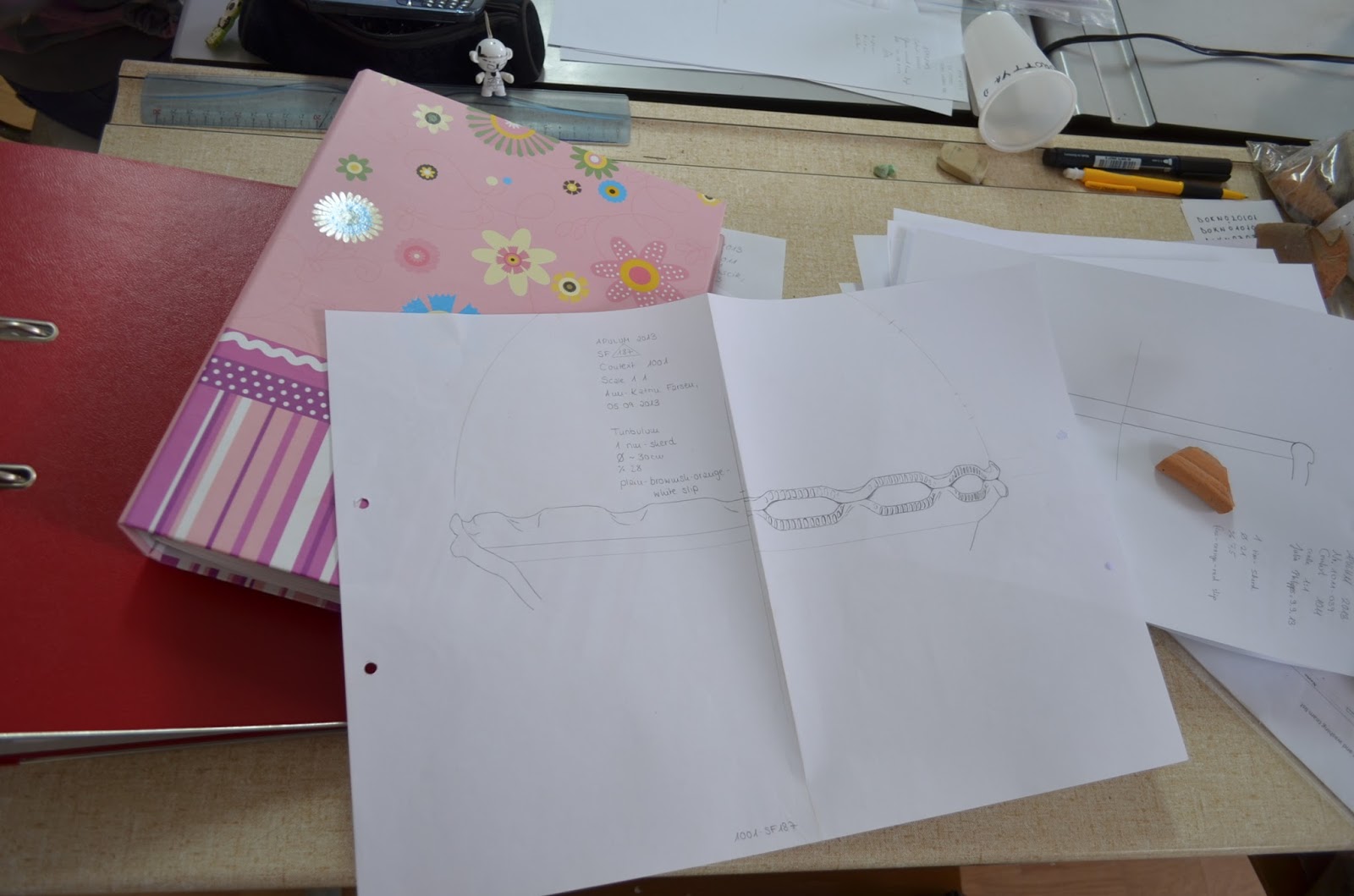
Drawing pottery is going on - training some students with good results. Even complicated vessels like decorated turibula can be done after one day of exercise. Some students do enjoy staying in the lab
after weeks on site.
Why is pottery drawing so important?
Pottery is a tool to date the contexts and learn more about the function and the economical background of the site. Therefore we need the drawings of the fragments to determine the types of the vessels.
No artistic skills are needed to draw pottery: everybody can learn it! But some students have more patience than others...
Climbing to Piatra Craivii
On
Saturday, after the site tour, a small but very enthusiastic group of
researchers and students climbed up to Piatra Craivii in the Trascău Mountains. This 1078 meters high peak is famous not
only because of its fascinating shell-shaped white cliff but also for its
historical background.
Some thousand years ago a Dacian (late Iron Age) fortification stood on
the top of Piatra Craivii, and the remains of ancient life was also visible on
the slopes around the peak.
Our hikers came up from the little village of Craiva and after exhausting
climbing they reached the final ridge of the hill. From that point we followed
the blue hiking trail sign to the top, where an iron cross represented the end
of our efforts and rewarded us with a breathtaking view.
Visiting history
On the third weekend of the project, the group
had an excursion to two of the most important historical sites of the region –
to the Hunedoara/Vajdahunyad Castle and to the ruins of the Roman settlement
Colonia Ulpia Traiana Sarmizegetusa. The Hunedoara Castle is a late
Gothic-Renaissance style castle which was mainly built in the second half of
the 15th century. Its construction was started by Jancu de
Hunedoara/János Hunyadi, the famous governor and the father of King Matia
Corvin/Mátyás Hunyadi who was one of the most prominent rulers of medieval
Hungary.
Colonia Ulpia Traiana Sarmizegetusa was perhaps
the most important settlement of Roman Dacia. It was founded right after the
conquest of Dacia by the orders of Emperor Traianus, as it is attested by an
inscription: Auspiciis / [Imp(eratoris)]
Caes(aris) divi Nervae f[il(ii)] / [Nervae] Traiani Augusti / [Germ(anici)
Dac(ici)] condita colonia / [Ulpia Traiana Augusta] Dacica / [Sarmizegetusa]
per / [D(ecimum) Terenti]um Scaurianum / [legatum] eius pro pr(aetore) /
[------? (Translation: “By the orders of Imperator Caesar Nerva Traianus
Augustus Germanicus Dacicus, son of the divine Nerva, the colony of Ulpia
Traiana Augusta Dacica Sarmizegetusa was settled by Decimus Terentius
Scaurianus, his governor.”) The settlement was the seat of the financial procurator of Dacia, and the concilium provinciae (a religious
festivity in honour of Rome and the Emperor) was also held in the city
annually.
Subscribe to:
Posts (Atom)