Pages

Friday, 6 September 2013

The world of pottery


Different steps of the pottery processing have been going on in the restorer’s laboratory and also in the finds processing room from the basement. The lately enormous amount of pottery (9 crates) is washed and dried in the upper lab and this is the location of the primary recording of the ceramic as well.


The pottery recording sheet contains different ware types and functional categories and helps us to have an overview about all the ceramic material. In the finds processing room students learn how to draw the typical pottery shards (rim, base, decorated body fragments, etc.) and record them in the pottery database. Many interesting fragments (turibula, paterae, miniature vessels, etc.) are already recorded in the database and some of them are carefully cleaned from the sintering crust as well. A different part of the pottery recording is the identification of ceramic fabrics and the definition of the local and imported wares, from which important information can be extracted related to the economic connections of Apulum and refers also to the consumption habits of the local population.


From the world of small finds


During the last two weeks of the excavation, a large number of various small finds have been unearthed by the archaeologists and students on the site, which are being processed in the lab. Until now, more than six hundred finds have been processed – all of them drawn, measured and recorded into our database, and some of them restored as well. Among them are silver and bronze coins, fine imported pottery, worked bone objects (e. g. hairpins, needles), glass beads, various iron and bronze objects (e. g. brooches, belt fittings) and worked stone fragments (e. g. statue fragments). All of these finds are of utmost importance, since they carry some extra information and through their analysis in the lab, they help us to improve our knowledge about the functionality, chronology and the general land use of our site and its vicinity in the Roman period.

Thursday, 5 September 2013

GIS mapping team


In parallel with the excavation, a group of researchers and students, called the GIS mapping team, work in the lab. This team is dealing with all the drawn documentation and data which has geographic or topographic information.


Firstly the plans which correspond to the individual archaeological contexts of the excavation are scanned and rectified based on the grid coordinates. Every drawing is digitised and the data is stored in the form of vector layers. We use different layers depending on the type of the information, for example: contexts line, elevation data or find spots of small finds.


With the help of a geographic information system our research has an up-to-date background to analyze, display and understand different aspects of the excavation.

Wednesday, 28 August 2013

Lecture series


At the first two days of the IP a block of introductory lectures have been held, which guided us into the art and archaeology of the Roman period, the town of Apulum and the research methodology of the project. The lectures of the first week were related to the history of the city, the archaeological discoveries, cultic discoveries and many other interesting topics, which offered a wide knowledge about the location where the excavation is taking place, in the most entertaining way. Besides the large amount of information, we were delighted by the interactive methods that were used during the presentations. On the third day the participants visited the city and the archaeological museum, which further expanded the knowledge of the students about the history and beautiful monuments of Alba Iulia.

Tuesday, 27 August 2013

News from the lab


In parallel with the excavation, a small group of archaeologists, researchers and students, called the lab-people, work at the university, located in the centre of the fortress, right next to the principia of legionary fort. This laboratory is dealing with all the finds that come from the site: pottery, animal bones and small finds.
All those ceramic fragments that are collected at the excavation are washed, quantified and the typical fragments are photographed and drawn, so afterwards a great deal of statistical information helps us to understand different aspects of the site.


The small find-team has the honor of recording all the finds belonging to the special material categories: glass, metal, worked bone, stone and rare types of pottery. They make the small find cards, they draw it, take photos and measurements of all the pieces, and they also introduce all this information – along with others coming from the site – into a database. They look for analogies and try as hard as they can to date the different contexts of the site.


The badly preserved finds or many fragments of the same vessel are sent to the restoration laboratory, where from the ashes of old things some marvelous pieces are reborn.
In all these processes from day to day a larger amount of students are taking part, learning the basics of pottery and small find registering and restoration.

Excursion to Alburnus Maior


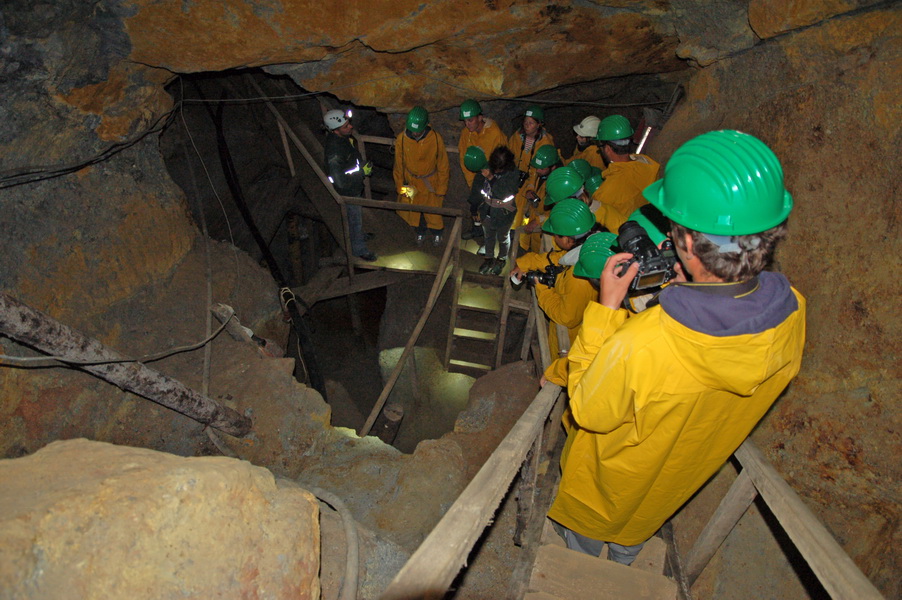
On the 25th of August, the participants of the Erasmus IP visited Roşia Montană/Verespatak (Alburnus Maior), which was one of the most important gold mining sites of Roman Dacia. Several mining galleries have been identified during the archaeological researches, and the site is also famous as the findspot of the famous Roman wax writing tablets. Besides these unique finds, the civilian settlement of Alburnus Maior has also yielded some important epigraphic monuments. These altars and stela frequently attest the presence of Illyrian miner colonists, who lived in the settlement and worked in the mines, since they were experts in gold and silver mining in their homelands.
Beneath the small town of Rosia Montana one of the largest gold deposit in the World are buried, so due to the fact that the joint venture Rosia Montana Gold Corporation (RMGC) secured the license to extract the deposit by strip-mining, the country and also the wider public is divided because of its environmental issues and the endangerment of the historical and archaeological heritage of the area.

The project T-Shirt

We finished the brainstorming about the project T-shirt. Here is the result!